
Upper near or intermediate
A separate upper segment can be set for the overhead controls or display distance the wearer needs.
Eyewear Advice · Sports & Hobbies
A conventional progressive helps you look ahead and down. Pilots may also need clear near or intermediate vision above eye level for overhead switches, displays, or controls. The IOT Endless Pilot Progressive adds a specialized upper viewing segment for that task.
The Short Answer
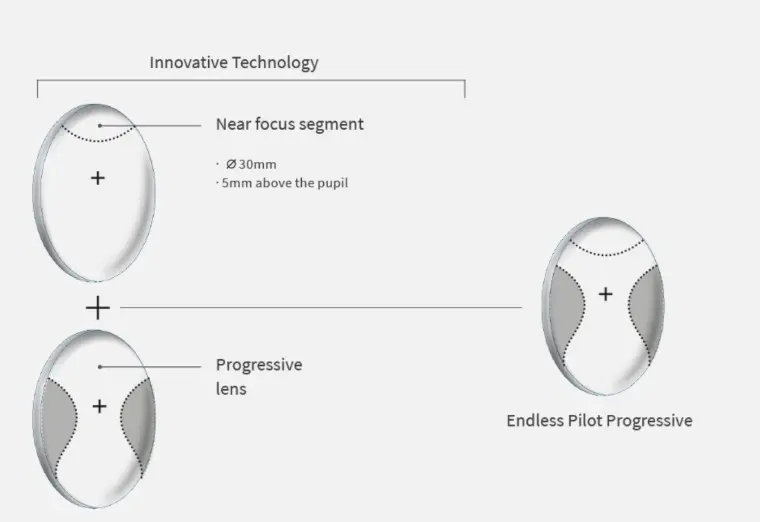
The IOT Endless Pilot Progressive places distance and the normal progressive transition through the main lens, including intermediate and near vision below. It then adds a separate segment near the top of the lens that can be set for a fixed near or intermediate distance.
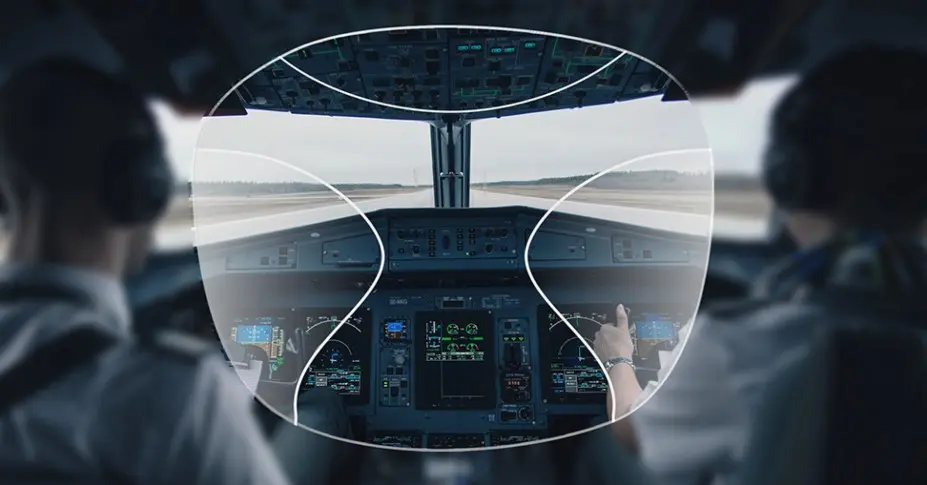
That upper segment allows the wearer to glance upward at an overhead task without lifting the chin or searching through a distance-only area. The goal is to match the lens to the pilot's real vertical scan: up, forward, and down.
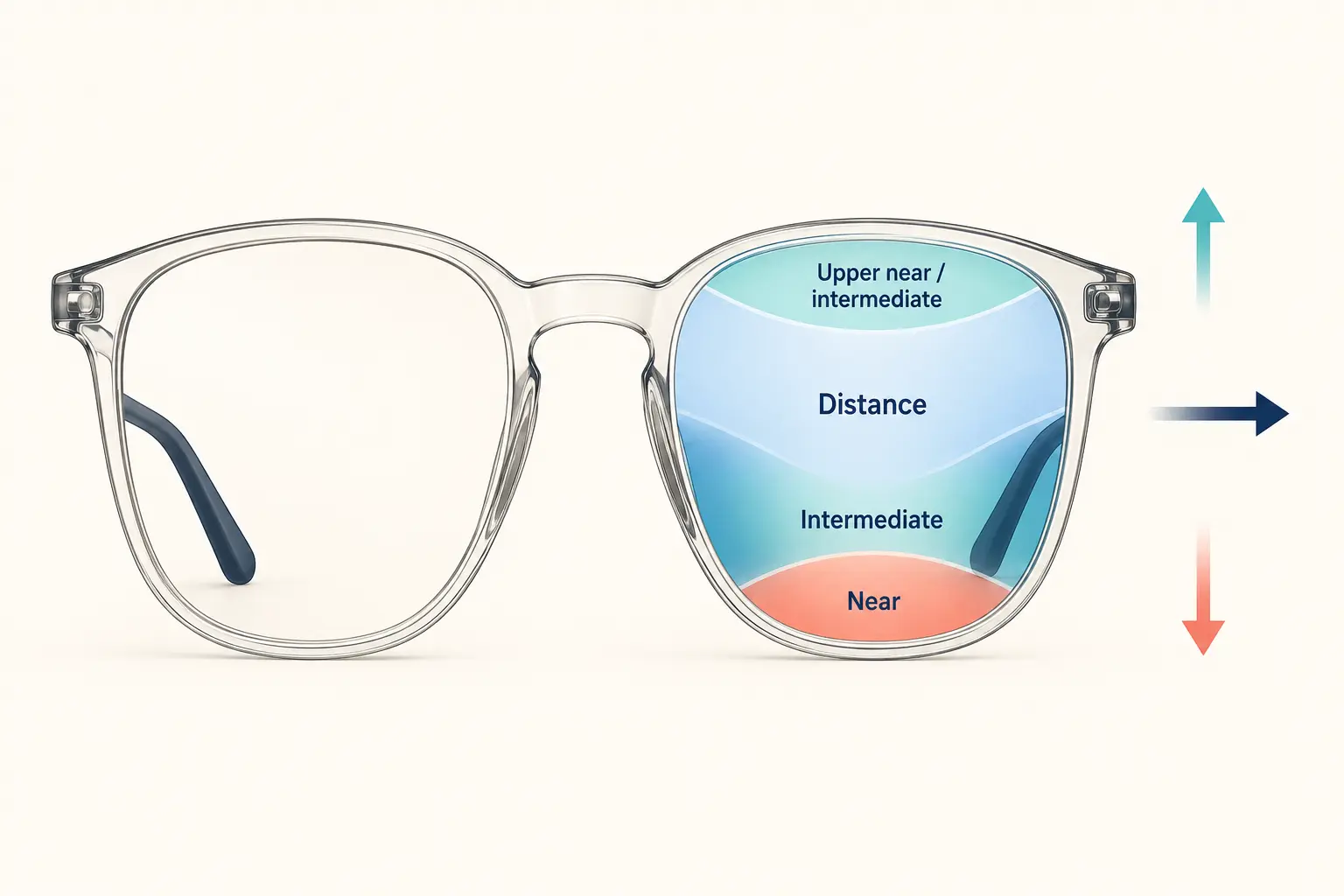
Four Viewing Areas
A separate upper segment can be set for the overhead controls or display distance the wearer needs.
The central distance area supports the horizon, outside scanning, runway environment, and other far targets.
The progressive transition can serve instruments and avionics located below the main line of sight.
The bottom near area supports charts, checklists, a kneeboard, controls, or handheld devices at closer distances.
IOT Digital Ray-Path 2 calculations incorporate prescription, design, and available individualization data.
The upper power target should reflect the pilot's actual overhead task rather than a generic reading distance.
Why a Standard Progressive May Fall Short
Traditional progressives place distance through the upper lens, intermediate through a transition below it, and near at the bottom. That arrangement fits many everyday tasks but does not provide additional near power when the wearer looks upward.
A pilot trying to view an overhead control may compensate by lifting the chin, leaning, or looking through an area designed for distance. The Endless Pilot architecture addresses that specific mismatch by adding a second near or intermediate area above the fitting cross.
Related: how frame choice affects progressive lenses →The Upper Segment
IOT describes a 30-millimeter upper segment centered 5 millimeters above the fitting cross. That segment can be configured for a fixed near or intermediate distance, allowing the wearer to access the overhead target with an upward glance.
Those published design dimensions do not eliminate the need for individual fitting. The relationship among the pilot's habitual posture, overhead target, central distance view, frame depth, eye position, and segment placement still determines whether the finished glasses make sense for the cockpit.
Cockpit Measurements
Measure from the eyes in the normal seated position to the overhead controls, primary panel, avionics, charts, and devices. Photographs from the pilot's point of view can help show where each task falls vertically.
The dispensing measurements should be taken with the chosen frame adjusted on the wearer. Monocular pupil distances, fitting heights, vertex distance, pantoscopic tilt, wrap, bridge position, and frame stability all influence how the design sits relative to the eyes.
A Specialized Tool
IOT categorizes Endless Pilot as a personalized, special-use lens intended for occasional wear. Its extra upper segment solves a specific visual problem, but it also changes the upper lens. The decision should be based on the pilot's cockpit, prescription, posture, duties, and willingness to use a task-specific pair.
Frame Selection
The frame needs enough usable vertical depth for the upper segment, central distance area, lower progression, and near zone. Eye position should not crowd the top or bottom of the lens, and the bridge should hold the measured height consistently.
Temples should remain comfortable beneath the pilot's headset without shifting the frame or disrupting the seal. The prescription, frame shape, lens material, coatings, and position of wear should be planned as one system.
Related: choosing the complete pair of pilot glasses →What IOT Personalization Means
IOT says Endless Pilot uses Digital Ray-Path 2 Technology and can incorporate individualization parameters describing the frame and wearer. The design is calculated point by point to manage how prescribed power is perceived through different gaze directions and working distances.
The manufacturer also states that the design is compatible with any blank provider and lens index and with available lab coatings. Actual options depend on the prescription, frame, laboratory, material availability, and the professional ordering the lenses.
Pilot Progressive FAQ
A pilot progressive is a specialized multifocal lens designed around cockpit viewing demands. The IOT Endless Pilot Progressive combines a standard lower progression with an additional upper near or intermediate segment for controls or information located above eye level.
A standard progressive usually places distance above and near below. Endless Pilot retains the lower progression and adds a separate upper segment that can be set for a fixed near or intermediate working distance.
The upper segment occupies a defined area rather than the entire upper lens. Its placement, size, power, frame, and the wearer's posture must be planned carefully so the remaining distance area works for the pilot's normal line of sight.
IOT categorizes Endless Pilot as a special-use lens with occasional frequency of use. Some wearers may find it useful beyond the cockpit, but the design should be selected for the actual task rather than assumed to replace every everyday pair.
Accurate prescription, monocular pupil distances, fitting heights, frame position, and position-of-wear measurements are important. The upper working distance, normal seated posture, overhead-control location, lower panel distance, and device distances should also be discussed.
IOT states that the design is compatible with any blank provider and lens index and with available lab coatings. Actual material, treatment, prescription, frame, and lab availability should be confirmed for the individual order.
Manufacturer Source
Product architecture, design dimensions, compatibility, technology, and intended-use information are based on IOT's current Endless Pilot Progressive documentation. Manufacturer descriptions are not a guarantee of individual performance.
IOT Endless Pilot Progressive ↗